PHP Web App Development: Complete Guide 2026 - Build Applications with PHP
Complete guide to PHP web app development: how to build web applications with PHP, frameworks, best practices, costs, and everything you need to know about developing PHP web apps in 2026.
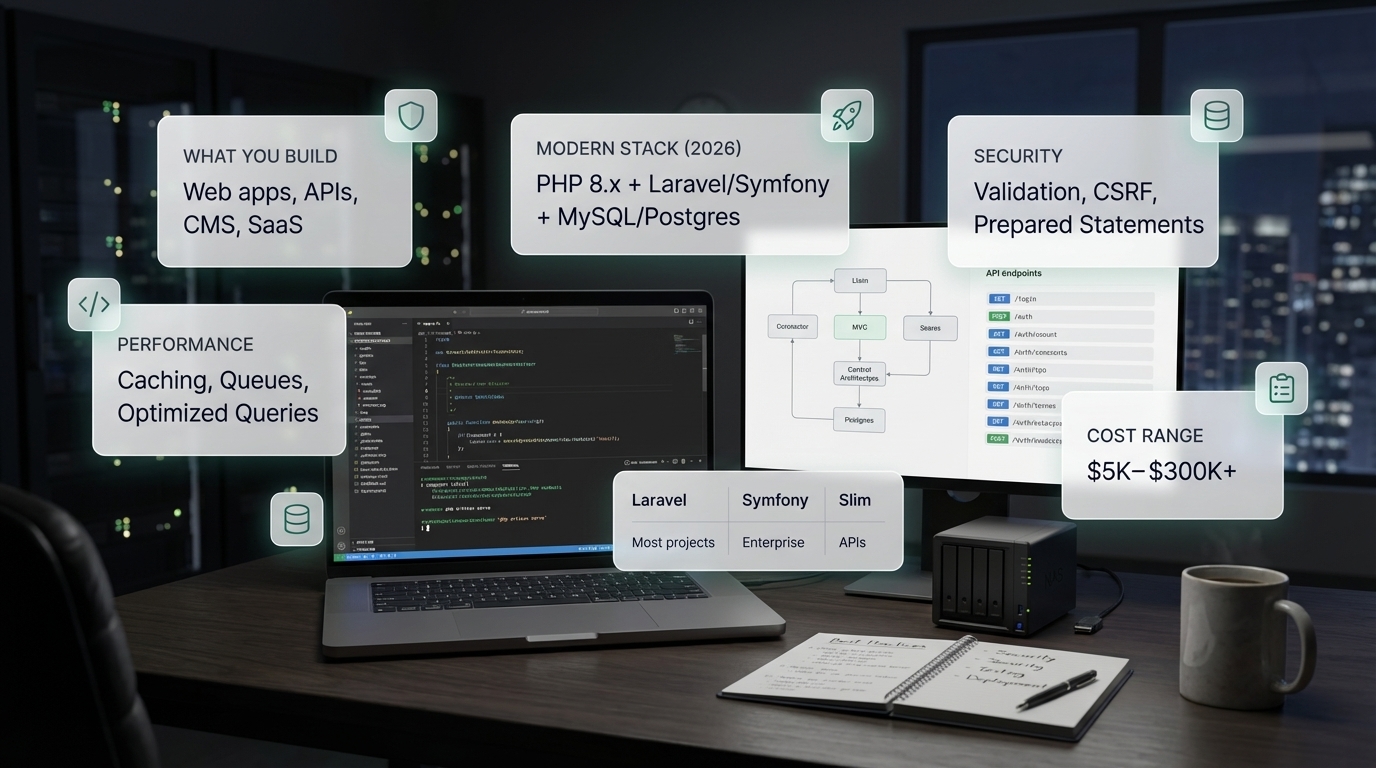
What is PHP Web App Development? (Quick Answer)
PHP web app development is the process of creating web applications using PHP (Hypertext Preprocessor), a server-side scripting language designed for web development. PHP powers millions of websites and is particularly well-suited for building dynamic web applications, content management systems, e-commerce platforms, and APIs.
Modern PHP web app development uses PHP 8.x with frameworks like Laravel or Symfony, offering excellent performance, security, and developer experience. PHP remains one of the most popular choices for web development in 2026.
If you need custom web app development, learn more about our desarrollo de software a medida services. Check out our servicios de desarrollo de software a medida for custom PHP solutions.
Understanding PHP Web App Development
What is PHP?
PHP (Hypertext Preprocessor) is a server-side scripting language:
PHP Characteristics
- Server-side language (runs on server, not browser)
- Open-source and free to use
- Powers over 75% of all websites
- Excellent database integration
- Large ecosystem of frameworks
- Wide hosting availability and low cost
- Easy to learn and use
- Active development (PHP 8.x is modern and fast)
What PHP Web Apps Can Build
| Application Type | Description | Examples |
|---|---|---|
| Content Management Systems | CMS platforms for managing content | WordPress, Drupal |
| E-commerce Platforms | Online stores and marketplaces | Magento, WooCommerce |
| Web APIs | RESTful APIs for mobile/web apps | Backend APIs |
| Social Media Platforms | Social networking applications | Facebook (originally PHP) |
| SaaS Applications | Software as a Service platforms | CRM, project management |
| Blogs and Websites | Dynamic websites and blogs | Custom websites |
| Enterprise Applications | Large-scale business applications | ERP, intranets |
PHP Web App Development Process
Complete Development Workflow
-
Set Up Development Environment
Install PHP and tools: Install PHP 8.x (latest version), Choose local server (XAMPP, WAMP, Laragon, or Docker), Install Composer (PHP dependency manager), Install code editor (VS Code, PHPStorm), Set up Git version control. Modern PHP development requires PHP 8.x for best performance. Use Composer for managing dependencies and frameworks. Local development setup is essential before coding.
-
Choose PHP Framework
Select framework: Laravel (recommended - most popular, best for beginners), Symfony (enterprise-grade, highly flexible), CodeIgniter (lightweight, easy to learn), Or build without framework (for simple apps). Frameworks provide: Security features, Database abstraction, Routing, Authentication, Testing tools. Laravel is recommended for most projects due to excellent documentation and ecosystem. Framework choice depends on project complexity and team experience.
-
Plan Database Structure
Design database: Identify data entities and relationships, Create database schema, Design tables and relationships, Plan indexes for performance, Choose database (MySQL, PostgreSQL recommended), Use migrations (framework feature). Good database design is critical. Plan carefully before coding. Use migrations for version control of database changes.
-
Set Up Project Structure
Create project architecture: Initialize framework project, Set up MVC architecture (Model-View-Controller), Configure environment settings, Set up routing, Configure database connection, Set up authentication system. MVC pattern separates concerns: Models (data), Views (presentation), Controllers (logic). Follow framework conventions for best results.
-
Develop Backend Logic
Build server-side functionality: Create models for database interaction, Build controllers for business logic, Implement routing and endpoints, Develop authentication and authorization, Create API endpoints if needed, Implement security measures (validation, sanitization), Handle file uploads and processing, Build admin panel if required. Backend handles all server-side operations. Follow security best practices. Use framework features for common tasks.
-
Integrate Database
Connect to database: Configure database connection, Use ORM (Object-Relational Mapping) if using framework, Write queries (use prepared statements for security), Implement database migrations, Set up relationships between models, Optimize queries for performance, Implement database transactions. Always use prepared statements to prevent SQL injection. ORM makes database work easier and safer.
-
Build Frontend
Create user interface: Use framework's templating engine (Blade for Laravel, Twig for Symfony), Create views and layouts, Add CSS styling (Bootstrap, Tailwind, or custom), Add JavaScript for interactivity, Make responsive design for mobile, Integrate with backend APIs, Implement AJAX for dynamic content. Modern PHP apps often use separate frontend (React, Vue) with PHP API backend. Choose based on project needs.
-
Implement Security
Secure your application: Use prepared statements (prevent SQL injection), Validate and sanitize all inputs, Implement CSRF protection, Use password hashing (bcrypt, argon2), Implement authentication and authorization, Use HTTPS, Protect against XSS attacks, Validate file uploads, Implement rate limiting, Keep dependencies updated. Security is critical. Follow OWASP security guidelines. Use framework security features.
-
Test Your Application
Quality assurance: Write unit tests (PHPUnit), Perform integration testing, Test all functionality, Security testing, Performance testing, Cross-browser testing, User acceptance testing, Fix bugs found. Testing ensures quality. Use PHPUnit for PHP testing. Test-driven development (TDD) improves code quality.
-
Deploy to Production
Launch your PHP web app: Choose hosting (shared, VPS, cloud like AWS, DigitalOcean), Set up production server (Apache or Nginx), Configure PHP for production, Set up database on server, Deploy code (Git, FTP, or deployment tools), Configure domain and SSL certificate, Set up backups, Monitor performance, Configure error logging. Choose reliable hosting. Use managed hosting for easier deployment. Configure PHP properly for production (disable debug mode, optimize settings).
Best PHP Frameworks for Web App Development
Framework Comparison
Summary: Best PHP Frameworks
| Framework | Best For | Learning Curve | Performance |
|---|---|---|---|
| Laravel | Most projects, beginners | Easy | Good |
| Symfony | Enterprise, complex apps | Steep | Excellent |
| CodeIgniter | Simple to medium projects | Easy | Good |
| Yii2 | Large applications | Medium | Excellent |
| Slim | APIs, microservices | Easy | Fast |
Pro tip: Laravel is recommended for most developers - excellent documentation, large community, modern features, and beginner-friendly. Symfony is best for enterprise applications requiring maximum flexibility. CodeIgniter is good for simpler projects or learning. Choose based on project needs and team experience.
Laravel (Most Popular)
Why Laravel is recommended:
Laravel Advantages
- Excellent documentation and tutorials
- Large, active community
- Modern PHP features (composer, namespaces)
- Built-in authentication and authorization
- Eloquent ORM for database work
- Blade templating engine
- Artisan CLI for productivity
- Extensive package ecosystem
Other Popular Frameworks
| Framework | Type | Use Case | When to Choose |
|---|---|---|---|
| Laravel | Full-stack | General web apps | Most projects |
| Symfony | Full-stack | Enterprise apps | Complex, flexible needs |
| CodeIgniter | Full-stack | Simple apps | Quick development |
| Slim | Micro | APIs | RESTful APIs |
| Yii2 | Full-stack | Large apps | Performance-critical |
| Phalcon | Full-stack | High performance | Speed requirements |
PHP Development Skills Required
Essential Skills
Core Skills Needed
- PHP programming (OOP, latest PHP 8.x features)
- PHP framework (Laravel recommended)
- Database (MySQL, PostgreSQL) and SQL
- HTML, CSS, JavaScript (frontend basics)
- MVC architecture pattern
- RESTful API development
- Authentication and security
- Git version control
- Composer (PHP dependency manager)
- Testing (PHPUnit)
Development Cost Breakdown
PHP Web App Development Costs
Summary: PHP Development Costs
| Complexity | Cost Range | Timeline | Framework |
|---|---|---|---|
| Simple PHP App | $5K-$25K | 2-4 months | CodeIgniter/Laravel |
| Medium Complexity | $20K-$80K | 4-8 months | Laravel/Symfony |
| Complex Application | $80K-$300K+ | 8-18 months+ | Symfony/Laravel |
Pro tip: PHP development is cost-effective due to wide availability of developers and affordable hosting. Most businesses spend $25,000-$100,000 for professional PHP web app development. Framework choice (Laravel vs custom) affects cost. Get quotes from multiple developers.
Cost Factors
What Affects PHP Development Cost
- Project complexity and features
- Framework chosen (Laravel vs custom)
- Developer expertise and location
- Design requirements
- Database complexity
- Integration needs
- Security requirements
- Timeline and urgency
Is PHP Still Good in 2026?
PHP 8.x Modern Features
Yes, PHP is excellent for web development in 2026:
PHP 8.x Advantages
- JIT (Just-In-Time) compilation - 2-3x faster
- Modern syntax (attributes, enums, match expressions)
- Better type safety and error handling
- Active development and regular updates
- Large ecosystem and framework support
- Powers major platforms (WordPress, Facebook)
- Wide hosting availability and low cost
- Huge talent pool of developers
PHP vs Other Technologies
| Aspect | PHP | Node.js | Python | Ruby |
|---|---|---|---|---|
| Learning Curve | Easy | Medium | Easy | Easy |
| Performance | Good (PHP 8.x) | Excellent | Good | Medium |
| Hosting Cost | Low | Medium | Medium | Medium |
| Framework Options | Many | Many | Django, Flask | Rails |
| Community | Very Large | Large | Large | Medium |
| Best For | Web apps, CMS | Real-time apps | Data science | Rapid dev |
Getting Started with PHP Development
Step-by-Step Beginner Guide
-
Learn PHP Basics
Start with fundamentals: Learn PHP syntax and basics, Understand variables, arrays, functions, Learn object-oriented programming (OOP), Practice with simple scripts, Build small projects. Resources: PHP.net official documentation, PHP The Right Way guide, Online courses (Udemy, Codecademy), YouTube tutorials. Foundation knowledge is essential.
-
Set Up Development Environment
Install necessary tools: Install PHP 8.x, Set up local server (XAMPP or Laragon), Install Composer, Choose code editor (VS Code recommended), Install Git. Modern development requires proper tools. XAMPP is easiest for beginners (includes PHP, MySQL, Apache).
-
Learn a Framework
Choose and learn Laravel: Install Laravel via Composer, Follow Laravel documentation and tutorials, Build a simple project (blog, todo app), Understand MVC pattern, Learn Eloquent ORM, Practice routing and controllers. Laravel is most recommended. Excellent learning resources available. Build projects to practice.
-
Learn Database
Master database skills: Learn SQL fundamentals, Understand MySQL or PostgreSQL, Learn database design, Practice with Laravel migrations and Eloquent, Understand relationships (one-to-many, many-to-many). Database knowledge is essential for web apps. Use framework ORM for easier work.
-
Build Projects
Practice by building: Start with simple projects (CRUD apps), Build a blog or CMS, Create an e-commerce site, Build RESTful APIs, Deploy projects to hosting. Projects teach practical skills. Each project builds on previous knowledge. Create portfolio to showcase skills.
Best Practices for PHP Development
Code Quality and Security
PHP Development Best Practices
- Use PHP 8.x for best performance
- Follow PSR standards for code style
- Use frameworks for security and productivity
- Always use prepared statements (prevent SQL injection)
- Validate and sanitize all user inputs
- Implement proper error handling
- Use Composer for dependency management
- Write clean, readable code
- Use version control (Git)
- Test your code (PHPUnit)
- Follow MVC architecture pattern
- Keep dependencies updated
Fuentes y Recursos Externos
- Portal del Gobierno de Chile - Información oficial sobre desarrollo de software en Chile
FAQ
Frequently asked questions
What is PHP web app development?
PHP web app development is the process of creating web applications using PHP (Hypertext Preprocessor), a server-side scripting language designed for web development. PHP is particularly well-suited for building dynamic web applications, content management systems, e-commerce platforms, and APIs. PHP web app development involves: Server-side scripting and logic, Database integration (MySQL, PostgreSQL), Framework usage (Laravel, Symfony, CodeIgniter), RESTful API development, Authentication and authorization, Session management, File handling and processing, Integration with frontend technologies (HTML, CSS, JavaScript), Security implementation (SQL injection prevention, XSS protection), Performance optimization. PHP powers millions of websites including Facebook, WordPress, and many e-commerce platforms. It's known for ease of use, strong database integration, and extensive framework ecosystem. PHP 8.x offers modern features like JIT compilation, improved performance, and better type safety.
How do you develop a web application with PHP?
To develop a web application with PHP: 1) Set up development environment (XAMPP, WAMP, or Docker with PHP), 2) Choose a PHP framework (Laravel recommended for beginners, Symfony for enterprise), 3) Plan database structure and relationships, 4) Design application architecture (MVC pattern recommended), 5) Build backend API or server-side logic, 6) Integrate database (MySQL, PostgreSQL), 7) Implement authentication and security, 8) Create frontend (HTML/CSS/JavaScript or use framework like Vue.js/React), 9) Connect frontend to PHP backend, 10) Test thoroughly (unit tests, integration tests), 11) Deploy to hosting (shared hosting, VPS, cloud). Process: Planning (1-2 weeks), Development (6-20 weeks depending on complexity), Testing (2-4 weeks), Deployment (1 week). Use modern PHP 8.x for best performance. Follow PSR standards for code quality. Use frameworks for faster development and security.
What are the best PHP frameworks for web app development?
Best PHP frameworks for web app development: Laravel - Most popular, excellent documentation, beginner-friendly, robust features, recommended for most projects. Symfony - Enterprise-grade, highly flexible, component-based, best for complex applications. CodeIgniter - Lightweight, easy to learn, fast development, good for simple to medium projects. Yii2 - High performance, security-focused, good for large applications. Phalcon - Fastest PHP framework (C extension), high performance requirements. Slim - Micro-framework, minimal, perfect for APIs and small applications. Lumen - Laravel's micro-framework, fast, API-focused. CakePHP - Rapid development, convention over configuration. Framework choice depends on: Project complexity, Team experience, Performance requirements, Learning curve. Laravel is recommended for most developers due to excellent ecosystem, documentation, and community support. Symfony is best for enterprise applications requiring maximum flexibility.
How much does PHP web app development cost?
PHP web app development costs: Simple PHP web apps: $5,000-$25,000 (basic functionality, 2-4 months), Medium complexity: $20,000-$80,000 (custom features, 4-8 months), Complex applications: $80,000-$300,000+ (enterprise, 8-18 months+). Cost factors: Project complexity and features, Framework chosen (Laravel vs custom), Team size and expertise, Design requirements, Timeline and urgency, Integration needs, Security requirements. PHP development costs: Planning and design (10-15%), Backend PHP development (35-40%), Database design and integration (10-15%), Frontend development (20-25%), Testing and QA (10-15%), Deployment (5-10%). Hourly rates: PHP freelancers ($30-$100/hr), PHP agencies ($80-$200/hr), Enterprise teams ($150-$400/hr). Additional costs: Hosting ($50-$500+/month), Domain ($10-$50/year), Third-party services, Ongoing maintenance ($5,000-$30,000+/year). PHP is cost-effective compared to some other technologies due to wide availability of developers and hosting options.
Is PHP still good for web app development in 2026?
Yes, PHP is still excellent for web app development in 2026. PHP 8.x offers: Modern features (JIT compilation, attributes, enums), Significant performance improvements (2-3x faster than PHP 7), Better type safety and error handling, Active development and regular updates, Large ecosystem and framework support. PHP advantages: Ease of learning and use, Extensive documentation and community, Wide hosting availability and low cost, Strong database integration, Mature frameworks (Laravel, Symfony), Powers major platforms (WordPress, Facebook uses PHP), Huge talent pool of developers. PHP remains one of the most popular server-side languages, powering over 75% of all websites. Modern PHP (8.x) is fast, secure, and feature-rich. Laravel framework makes PHP development modern and efficient. PHP is ideal for: Content management systems, E-commerce platforms, Web APIs, Dynamic websites, SaaS applications. For new projects, PHP 8.x with Laravel is an excellent choice.
What skills do you need for PHP web app development?
Skills needed for PHP web app development: PHP programming (core language, OOP, latest PHP 8.x features), PHP framework (Laravel, Symfony, or CodeIgniter), Database (MySQL, PostgreSQL) and SQL queries, HTML, CSS, JavaScript (frontend basics), MVC architecture pattern, RESTful API development, Authentication and security (hashing, encryption, CSRF protection), Git version control, Composer (PHP dependency manager), Testing (PHPUnit, TDD), Server management (Apache, Nginx), Linux basics (command line), Problem-solving and debugging. Additional valuable skills: JavaScript frameworks (Vue.js, React for frontend), Docker and containerization, Cloud platforms (AWS, Google Cloud), CI/CD pipelines, API design and documentation, Performance optimization, Security best practices. Most important: Strong PHP fundamentals, Framework expertise (Laravel most in-demand), Database skills, Security knowledge.
Conclusion
PHP web app development remains a powerful and popular choice for building web applications in 2026. With PHP 8.x offering modern features, excellent performance, and frameworks like Laravel making development efficient, PHP continues to power millions of websites.
Key takeaways:
- PHP 8.x is modern and fast - JIT compilation, 2-3x performance improvement
- Laravel is recommended - Most popular framework, excellent for beginners
- Wide hosting availability - Affordable hosting options
- Large developer community - Extensive resources and support
- Cost-effective development - $5,000-$300,000+ depending on complexity
- Security is critical - Use frameworks, prepared statements, input validation
- Still relevant in 2026 - Powers 75%+ of websites, active development
Our recommendation: Start with PHP 8.x and learn Laravel framework - it’s the most beginner-friendly and has excellent documentation. Set up a proper development environment (XAMPP or Docker). Learn fundamentals first, then move to framework. Build projects to practice. For businesses, PHP development offers cost-effective solutions with Laravel or Symfony. Most businesses spend $25,000-$100,000 for professional PHP web app development. PHP remains an excellent choice for content management systems, e-commerce platforms, APIs, and dynamic web applications.
Ready to start PHP web app development? Begin with PHP basics, choose Laravel framework, and start building projects today!