Doctor Appointment App Development: Complete Guide 2026 - Build Healthcare Apps
Complete guide to doctor appointment app development: how to build appointment booking apps for healthcare, features, technologies, costs, HIPAA compliance, and everything you need to know in 2026.
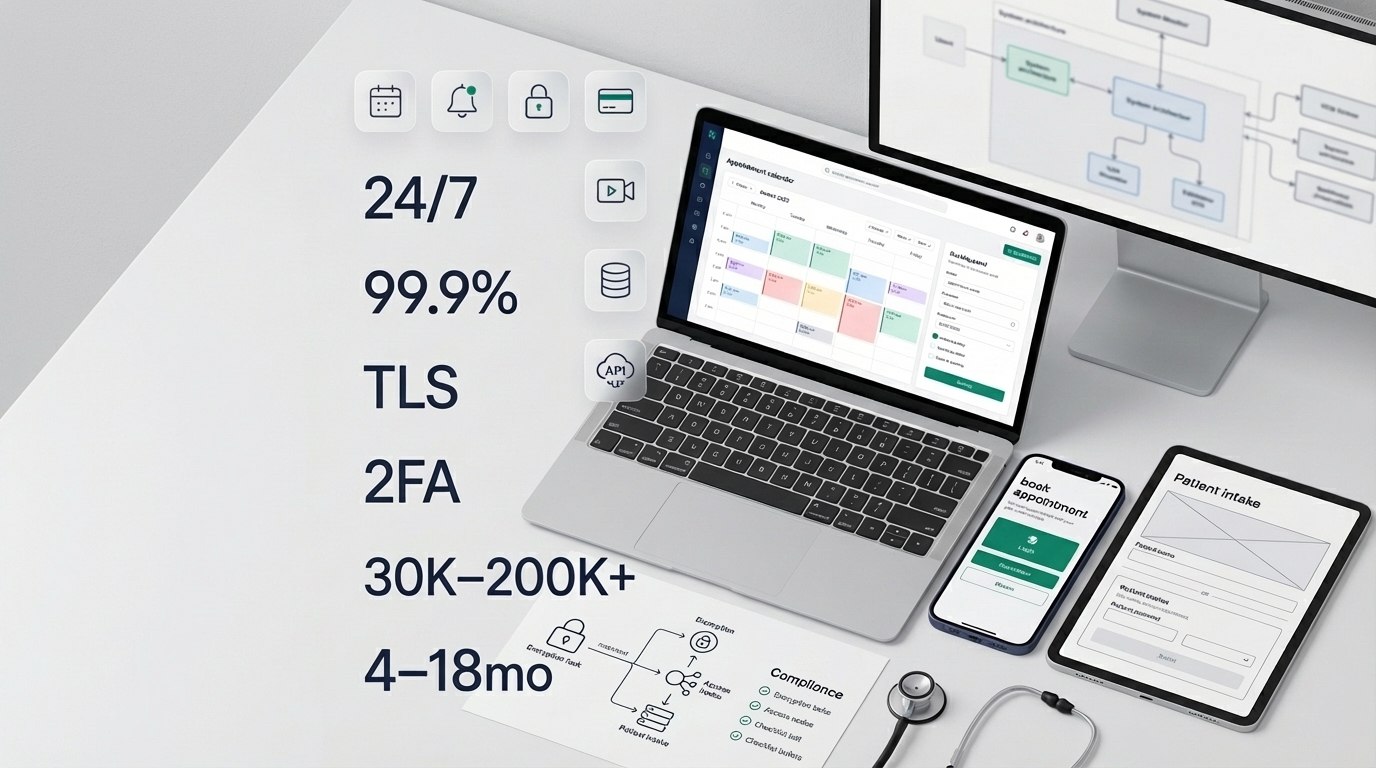
Doctor Appointment App Development: Complete Guide (Quick Answer)
Doctor appointment app development is the process of creating mobile or web applications that enable patients to book, manage, and cancel medical appointments with healthcare providers. These apps streamline appointment booking, reduce no-shows, and improve patient experience.
Doctor appointment app development requires HIPAA compliance, secure data handling, appointment scheduling systems, and user-friendly interfaces. Development costs range from $30,000-$200,000+ depending on features and compliance requirements.
If you need custom app development, learn more about our desarrollo de software a medida services. Check out our servicios de desarrollo de software a medida for HIPAA-compliant healthcare solutions.
Understanding Doctor Appointment App Development
What Are Doctor Appointment Apps?
Doctor appointment apps are healthcare applications that facilitate appointment booking:
What Appointment Apps Enable
- Schedule appointments with healthcare providers
- View doctor availability and time slots
- Cancel or reschedule appointments
- Receive appointment reminders
- Access appointment history
- Make payments for appointments
- Communicate with healthcare providers
- Access medical records (if integrated)
- Video consultations (advanced feature)
- Manage prescriptions and lab results
Types of Appointment Apps
| App Type | Description | Use Cases |
|---|---|---|
| Single Practice App | One healthcare practice or clinic | Small clinics, private practices |
| Multi-Practice App | Multiple practices or clinic network | Healthcare chains, networks |
| Specialty-Specific | Specific medical specialties | Dental, dermatology, etc. |
| Telemedicine Platform | Virtual consultations included | Remote healthcare |
| Enterprise Healthcare | Large hospital systems | Hospitals, medical centers |
Doctor Appointment App Development Process
Complete Development Workflow
-
Define Requirements and Features
Plan your appointment app: Identify target users (patients, doctors, admins), Define core features (booking, calendar, notifications), List advanced features (video consultations, prescriptions), Determine integration needs (healthcare systems, payment processors), Plan HIPAA compliance requirements, Set success metrics. Clear requirements guide development. Healthcare apps require careful planning due to compliance needs.
-
Plan HIPAA Compliance
Ensure compliance from start: Understand HIPAA requirements for Protected Health Information (PHI), Plan encryption and security measures, Design access controls and authentication, Plan audit logging, Set up Business Associate Agreements (BAAs), Plan breach notification procedures, Choose HIPAA-compliant hosting, HIPAA compliance is mandatory and must be built in from the start. Non-compliance can result in severe fines. Work with developers experienced in healthcare compliance.
-
Choose Development Platform
Select technology: Native iOS (Swift) - Best performance, iOS-specific features, Native Android (Kotlin) - Android optimization, Cross-platform (React Native, Flutter) - Single codebase, faster, lower cost. Recommendation: Cross-platform (React Native or Flutter) for most apps - develop once, deploy to both platforms, reducing cost and maintenance. Ensure platform supports HIPAA-compliant technologies.
-
Design User Interface
Create intuitive design: Design patient-facing interface (easy booking flow), Design doctor/admin interface (calendar management), Ensure accessibility compliance, Design for different user types (patients, doctors, admins), Plan user flows (registration, booking, reminders), Create responsive designs for all devices, Follow healthcare UI/UX best practices. Good design improves user adoption and reduces booking errors.
-
Build Backend Infrastructure
Develop server-side systems: Set up HIPAA-compliant hosting (AWS HIPAA, Azure HIPAA), Design appointment scheduling database, Build API endpoints for app communication, Implement user authentication and authorization, Create appointment management system, Set up calendar synchronization, Implement data encryption (in transit and at rest), Set up audit logging, Backend must be HIPAA-compliant. Security and encryption are critical.
-
Implement Appointment Booking System
Build core functionality: Create appointment scheduling logic, Implement calendar availability checking, Build time slot management, Add conflict detection (prevent double bookings), Implement booking confirmation system, Create cancellation and rescheduling features, Add waitlist functionality, Implement recurring appointment support. Appointment system is core functionality. Must handle edge cases and conflicts properly.
-
Add Notification System
Implement reminders and alerts: Set up push notifications for reminders, Implement SMS notifications (appointment confirmations), Add email notifications, Create notification templates, Schedule automated reminders (24 hours before, day before), Send cancellation confirmations, Notify doctors of new bookings, Notification system reduces no-shows significantly. HIPAA-compliant messaging required for PHI.
-
Integrate Payment Processing
Add payment capabilities: Integrate PCI-compliant payment processor (Stripe, PayPal), Implement secure payment flow, Add payment history and receipts, Handle refunds for cancellations, Support multiple payment methods, Ensure PCI compliance for payment data, Add insurance payment integration if needed, Payment processing must be secure and compliant. PCI compliance required for payment data.
-
Add Advanced Features (Optional)
Implement additional features: Video consultation integration (Zoom, Twilio), Prescription management system, Lab test results integration, Medical records access, Multi-language support, Integration with healthcare systems (Epic, Cerner), AI-powered appointment recommendations, Analytics and reporting dashboards. Advanced features increase value but also cost and complexity.
-
Ensure HIPAA Compliance
Verify compliance: Conduct security audit, Verify encryption implementation, Test access controls, Review audit logs functionality, Verify data backup and recovery, Test breach notification procedures, Ensure BAAs are in place, Conduct HIPAA compliance review, HIPAA compliance is ongoing requirement. Regular audits and updates needed. Work with HIPAA compliance experts.
-
Test Thoroughly
Quality assurance: Functional testing (all features work correctly), Security testing (vulnerability scanning), HIPAA compliance testing, Performance testing (app speed, load handling), User acceptance testing (doctors and patients), Integration testing (healthcare systems, payments), Test notification system, Test across different devices, Thorough testing ensures reliability and compliance.
-
Deploy to App Stores
Launch your app: Prepare app store listings, Submit to Apple App Store (iOS), Submit to Google Play Store (Android), Complete healthcare app requirements, Respond to review feedback, Monitor app performance, Plan user training and onboarding. Healthcare apps may require additional review. Ensure all compliance documentation is ready.
Essential Features
Patient Features
Summary: Essential Patient Features
| Feature | Purpose | Complexity |
|---|---|---|
| User Registration | Account creation | Low |
| Doctor Search | Find healthcare providers | Medium |
| Appointment Booking | Schedule appointments | High |
| Calendar View | View appointments | Medium |
| Notifications | Reminders and alerts | Medium |
| Payment | Pay for appointments | Medium |
| Cancel/Reschedule | Manage appointments | Medium |
Pro tip: Start with essential features: user registration, doctor search, appointment booking, calendar, notifications, and payment. Add advanced features (video consultations, prescriptions, medical records) in later versions. Focus on smooth booking experience first.
Doctor/Admin Features
Doctor and Admin Features
- Profile management (doctor information, specialties)
- Calendar and schedule management
- Availability settings (working hours, time slots)
- Appointment requests and approvals
- Patient management (view patient information)
- Notification management (preferences, alerts)
- Appointment history and analytics
- Revenue and payment tracking
- Multi-doctor practice management
- Reporting and analytics dashboard
Security and Compliance Features
HIPAA Compliance Features
- End-to-end encryption for all data
- Secure user authentication (multi-factor recommended)
- Access controls and user permissions
- Audit logs for all data access
- Secure data backup and recovery
- HIPAA-compliant hosting infrastructure
- Business Associate Agreements (BAAs)
- Breach notification procedures
- Data encryption at rest and in transit
- Regular security audits and updates
Technology Stack
Recommended Technologies
| Category | Technologies | Why |
|---|---|---|
| Mobile Framework | React Native, Flutter | Cross-platform, faster development |
| Backend | Node.js, Python (Django) | Scalable, secure |
| Database | PostgreSQL | HIPAA-compliant, reliable |
| Hosting | AWS HIPAA, Azure HIPAA | HIPAA-compliant infrastructure |
| Authentication | OAuth 2.0, JWT | Secure access |
| Payment | Stripe, PayPal | PCI compliant |
| Notifications | Firebase, Twilio | Push, SMS, email |
| Video | Zoom API, Twilio | Telemedicine |
HIPAA Compliance
Critical Requirements
HIPAA Compliance Checklist
- Encrypt all Protected Health Information (PHI)
- Implement access controls (who can access what)
- Create audit logs (track all PHI access)
- Secure authentication (passwords, MFA)
- Business Associate Agreements (BAAs) with all vendors
- Breach notification procedures
- Regular security risk assessments
- Employee training on HIPAA compliance
- HIPAA-compliant hosting (AWS HIPAA, Azure HIPAA)
- Data backup and disaster recovery
Important: HIPAA compliance is mandatory for apps handling patient data. Non-compliance can result in fines of $100-$50,000+ per violation.
Cost Breakdown
Development Costs
Summary: Doctor Appointment App Development Costs
| Complexity | Cost Range | Timeline | Features |
|---|---|---|---|
| Basic App | $30K-$80K | 4-6 months | Essential features |
| Medium Complexity | $80K-$150K | 6-10 months | Advanced features |
| Enterprise App | $150K-$500K+ | 10-18 months+ | Full-featured |
Pro tip: Most healthcare providers spend $80,000-$150,000 for professional doctor appointment apps. HIPAA compliance adds 10-15% to development cost but is mandatory. Factor in ongoing costs: maintenance ($5K-$20K/month), compliance audits, hosting ($500-$5K/month), third-party services.
Cost Factors
What Affects Development Cost
- Platform choice (native vs cross-platform)
- Number of features and complexity
- HIPAA compliance requirements (mandatory)
- Integration with healthcare systems
- Video consultation features
- Payment processing complexity
- Design requirements
- Timeline and urgency
Best Practices
Development Best Practices
Recommended Practices
- Ensure HIPAA compliance from day one
- Design intuitive, accessible user interfaces
- Implement robust appointment scheduling logic
- Add automated reminders to reduce no-shows
- Test thoroughly across devices and scenarios
- Plan for scalability as practice grows
- Integrate with existing healthcare systems
- Provide excellent user support
- Regular security updates and audits
- Monitor and optimize performance
FAQ
Frequently asked questions
What is doctor appointment app development?
Doctor appointment app development is the process of creating mobile or web applications that allow patients to book, manage, and cancel medical appointments with healthcare providers. Doctor appointment apps enable patients to: Schedule appointments with doctors, View available time slots, Receive appointment reminders, Cancel or reschedule appointments, Access medical history, Communicate with healthcare providers, Make payments for appointments. These apps streamline the appointment booking process for both patients and healthcare providers, reducing no-shows and administrative workload. Development involves: Mobile app creation (iOS, Android, or cross-platform), Backend infrastructure for appointment management, Integration with healthcare systems and calendars, Payment processing integration, Notification systems, HIPAA compliance for healthcare data security, User authentication and profiles. Development typically costs $30,000-$200,000+ depending on features and complexity.
How do you develop a doctor appointment app?
To develop a doctor appointment app: 1) Define requirements (patient booking, doctor management, features), 2) Ensure HIPAA compliance planning (critical for healthcare apps), 3) Choose platform (iOS, Android, cross-platform like React Native or Flutter), 4) Design user interface for patients and doctors, 5) Build backend infrastructure (appointment scheduling system, database, APIs), 6) Implement appointment booking and calendar management, 7) Add user authentication and profiles, 8) Integrate payment processing, 9) Implement notification system (reminders, confirmations), 10) Add video consultation features (optional), 11) Ensure HIPAA compliance and security, 12) Test thoroughly (functionality, security, compliance), 13) Deploy to app stores. Key considerations: HIPAA compliance is mandatory for healthcare apps handling patient data, Security and encryption are critical, Integration with existing healthcare systems may be needed, Calendar synchronization is essential, Payment processing must be PCI compliant. Development timeline: 4-12 months depending on complexity. Cost: $30,000-$200,000+.
What features should a doctor appointment app have?
Essential features for doctor appointment apps: Patient features: User registration and authentication, Search and browse doctors by specialty, View doctor profiles and availability, Book appointments (select date, time, doctor), Appointment calendar and history, Appointment reminders and notifications, Cancel or reschedule appointments, Payment processing for appointments, Access to medical records (if applicable), Video consultation capability (optional). Doctor/admin features: Doctor profile management, Calendar and schedule management, Appointment requests and approvals, Patient management, Availability settings, Notification management, Appointment history and reports, Revenue and payment tracking. Advanced features: Telemedicine/video consultations, Prescription management, Lab test results integration, Health records management, Multi-language support, Integration with insurance systems, AI-powered appointment recommendations, Analytics and reporting dashboards. Security features: HIPAA compliance, End-to-end encryption, Secure authentication, Data backup and recovery.
How much does doctor appointment app development cost?
Doctor appointment app development costs: Basic appointment app: $30,000-$80,000 (essential features, 4-6 months), Medium complexity: $80,000-$150,000 (advanced features, 6-10 months), Enterprise healthcare app: $150,000-$500,000+ (full-featured, 10-18 months). Cost breakdown: Mobile app development: 35-40%, Backend infrastructure: 25-30%, HIPAA compliance and security: 10-15%, UI/UX design: 10-15%, Testing and QA: 8-12%, Deployment: 5%. Factors affecting cost: Platform choice (native vs cross-platform), Number of features, HIPAA compliance requirements, Integration with healthcare systems, Video consultation features, Payment processing complexity, Design requirements, Timeline. Additional costs: Ongoing maintenance ($5,000-$20,000/month), HIPAA compliance audits, Healthcare system integrations, Server and hosting costs, Third-party services. Most healthcare providers spend $80,000-$150,000 for professional doctor appointment apps.
What is HIPAA compliance for appointment apps?
HIPAA (Health Insurance Portability and Accountability Act) compliance is mandatory for doctor appointment apps that handle Protected Health Information (PHI). HIPAA requirements include: Administrative safeguards (policies, procedures, training), Physical safeguards (facility access controls), Technical safeguards (encryption, access controls, audit logs), Breach notification procedures, Business Associate Agreements (BAAs) with vendors, Risk assessments and management, Access controls and user authentication, Data encryption (in transit and at rest), Audit logs for all data access, Secure data backup and recovery. HIPAA compliance adds significant cost (10-15% of development) but is legally required. Non-compliance can result in fines of $100-$50,000+ per violation. Work with developers experienced in HIPAA-compliant app development. Compliance must be built in from the start, not added later.
What technologies are used for doctor appointment app development?
Technologies for doctor appointment app development: Mobile frameworks: React Native, Flutter (cross-platform), Native iOS (Swift), Native Android (Kotlin). Backend: Node.js, Python (Django), Ruby on Rails, Java. Databases: PostgreSQL (HIPAA-compliant), MongoDB (with proper security), Firebase (with HIPAA considerations). Security: End-to-end encryption, HIPAA-compliant hosting (AWS HIPAA, Azure HIPAA), OAuth 2.0 authentication, SSL/TLS encryption. Payment: Stripe (PCI compliant), PayPal, Healthcare payment processors. Notifications: Push notifications, SMS, Email. Additional: Calendar APIs (Google Calendar, iCal), Video conferencing (Zoom API, Twilio), Healthcare APIs (Epic, Cerner integrations). Popular stack: React Native/Flutter + Node.js + PostgreSQL + AWS HIPAA-compliant hosting. HIPAA compliance is critical - ensure all technologies and vendors are HIPAA-compliant.
Conclusion
Doctor appointment app development creates mobile applications that streamline appointment booking for healthcare providers and patients. These apps require HIPAA compliance, secure data handling, and user-friendly interfaces for both patients and healthcare providers.
Key takeaways:
- HIPAA compliance is mandatory - Must be built in from the start, not added later
- Essential features - Booking, calendar, notifications, payment processing
- Development cost - $30,000-$200,000+ depending on features and complexity
- Security is critical - Encryption, access controls, audit logs required
- Cross-platform recommended - React Native or Flutter for cost efficiency
- Notification system - Reduces no-shows significantly
- Integration - May need to integrate with existing healthcare systems
Our recommendation: Start with HIPAA compliance planning from day one - it’s mandatory and can’t be added later. Choose cross-platform development (React Native or Flutter) to reduce cost and time. Focus on essential features first: appointment booking, calendar management, notifications, and payment. Ensure all vendors and hosting are HIPAA-compliant. Work with developers experienced in healthcare app development. Most healthcare providers spend $80,000-$150,000 for professional doctor appointment apps. Plan for ongoing maintenance ($5,000-$20,000/month) and compliance audits. Security and compliance are not optional - they’re required by law.
Ready to start your doctor appointment app development? Follow this guide and ensure HIPAA compliance from the beginning!